

Introduction: The Grand Illusion of Arrival
Passing a proprietary trading firm challenge is a monumental, dopamine-fueled achievement. Whether you are trading with Funding Pips, FTMO, or FundedNext, receiving that "Passed" certificate and your live account credentials provides a massive rush of euphoria. You take a screenshot, post it on Twitter or Instagram, and you genuinely feel like you have finally made it. You have escaped the rat race. You are a "Funded Trader."
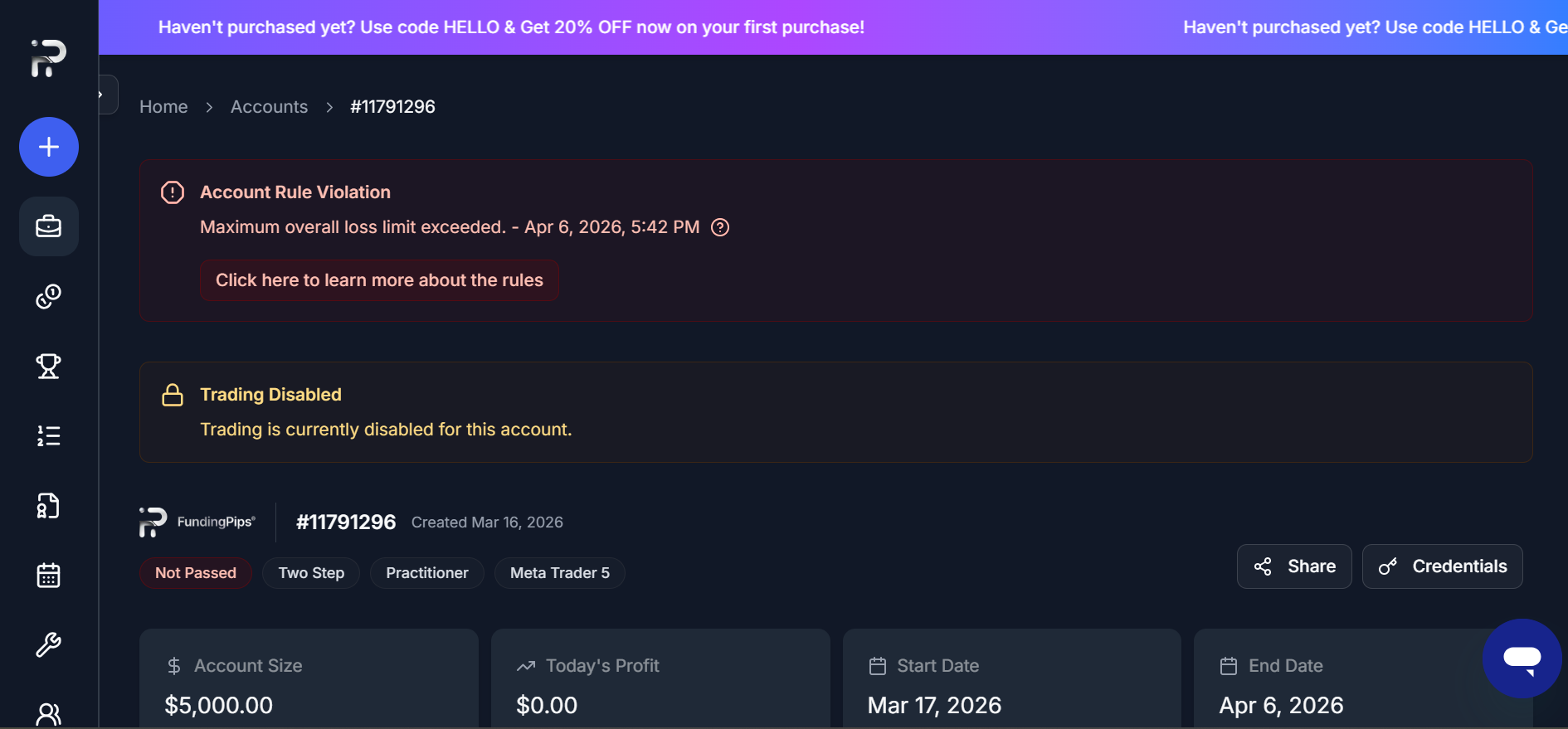
However, if you strip away the social media hype and look closely at the internal, highly guarded statistics of these proprietary trading firms, a terrifying reality emerges: Over 80% of traders who successfully reach the funded stage will blow their live account before they ever request their first payout.
Think about the gravity of that statistic. These are not beginners. These are traders who possess the technical skill to generate an 8% return while managing strict drawdown limits. Yet, the moment they touch the live capital, they self-destruct. This phenomenon is not caused by a sudden, mystical loss of technical ability. It is a profound, devastating psychological collapse known as the "Illusion of Arrival."
In this comprehensive Zemach Media masterclass, we are going to expose the psychological traps of the funded phase, redefine the mathematics of your live account, and give you the exact mental blueprint to survive your first 30 days and secure that life-changing first payout.

Chapter 1: The Dopamine Trap and The Finish Line Fallacy
To understand why funded traders fail, we must look at the neuroscience of the evaluation phase. During the challenge phase, your brain is hyper-focused. You have a clear, mathematical target (usually 8% or 10% profit), you often have a sense of urgency, and you trade with the aggression of a hunter tracking its prey.
Your brain is constantly releasing dopamine as you inch closer to that 8% goal. But the exact microsecond you pass the challenge, the target disappears. Suddenly, there is no finish line. The game fundamentally changes from a "growth and conquer" mindset to a "preservation and extraction" mindset. This sudden shift shatters the emotional stability of the average retail trader.
Without the 8% target, the trader suddenly feels lost. They open their terminal on Monday morning and ask, "Well, how much should I make today?" This lack of a defined objective leaves a vacuum in the trader's mind, and that vacuum is immediately filled by two deadly demons: Greed and Fear.
Chapter 2: The Two Demons of the Live Arena
Once the finish line is removed, the funded trader typically falls victim to one of two psychological extremes.
Demon 1: Payout Anxiety and The Lamborghini Complex (Overtrading)
The primary killer of newly funded accounts is Payout Anxiety. When a trader logs into their fresh $100,000 funded account, they immediately start doing the math. "If I make just 5% this month, that's $5,000. After the 80% split, I get a $4,000 payout. That is life-changing money! I can quit my job!"
This financial daydreaming instantly detaches the trader from the present reality of the algorithmic market. They stop trading their proven system, and they start trading their financial desires. Because they want that payout so desperately, they begin forcing setups. They ignore their Weekly Profile and Daily Bias. They take low-probability trades during the dead Asian session, or they try to catch falling knives during high-impact CPI news. They overtrade themselves straight into a blown account in less than a week.
Demon 2: The Fear of Loss (Micro-Management)
The opposite extreme is absolute terror. During the challenge, the money felt like a video game. Now, the money is "real." The trader becomes terrified of seeing red on their dashboard. This fear manifests in severe trade micro-management.
- Choking Winners: The trader enters a perfect Order Block setup targeting a 1:3 Risk-to-Reward. As soon as the trade hits 1:1, the fear of losing the unrealized profit kicks in, and they close the trade early.
- Moving Stops to Break-Even Prematurely: Terrified of taking a full 1R loss, they move their stop loss to break-even the second the trade moves slightly in their favor. The algorithm naturally retraces, stops them out at break-even, and then rockets to their Take Profit.
By cutting winners short and taking full losses on the bad trades, the math of their strategy completely collapses.
Chapter 3: The True Mathematics of a Funded Account
If you want to survive, you must accept a hard, mathematical truth: You do not actually have a $100,000 account.
Retail traders fail because they risk their capital based on the gross account size. Let us break down the reality. If you have a $100,000 funded account with a maximum absolute drawdown limit of 10% ($10,000), your true trading capital is only $10,000. The remaining $90,000 is phantom leverage provided by the firm to allow you to trade larger lot sizes.
If you risk 1% of the gross balance per trade ($1,000), you think you are risking a conservative amount. But mathematically, you are risking 10% of your actual capital ($10,000) on a single setup! If you hit a completely normal 4-trade losing streak, you have just lost 40% of your lifeline. Panic sets in, revenge trading begins, and the account is gone.
Chapter 4: The Architect's First Payout Protocol
To survive the funded phase, you must adopt the mindset of a digital mercenary. Your first and only objective upon receiving a funded account is to secure the "First Payout Buffer." You are not trying to get rich in your first month; you are trying to refund your challenge fee and build a psychological cushion.
Step 1: Slice Your Risk in Half
The moment you get funded, you must mechanically reduce your risk. If you were risking 0.5% per trade during the evaluation, you immediately drop your risk to 0.25% (or even 0.10%) per trade on the live account. This keeps you mathematically insulated from the inevitable losing streaks that the algorithm will throw at you. Use our Free Position Size Calculator rigorously on every single entry.
Step 2: Set a "Buffer" Target
Your goal for the first payout cycle should be a modest 2% to 3% gain. Do not aim for 10%. If you hit 3% on a $100K account, that is $3,000. Even after an 80/20 profit split, you walk away with $2,400 of clean profit, plus the refund of your initial evaluation fee.
Step 3: Stop Trading and Withdraw
Once you hit that 2% or 3% buffer, stop trading. Close the laptop. Walk away. Wait for the payout date, request your withdrawal, and let the money hit your actual bank account or crypto wallet. This is the most crucial psychological step.

Chapter 5: Post-Payout Psychology (Playing with the Casino's Money)
Once that first payout hits your bank account, something magical happens in your brain. The psychological weight lifts entirely. The desperation vanishes. You have effectively removed your initial risk (the challenge fee) from the table.
You are now playing with the casino's money. You have successfully transitioned from a desperate retail gambler trying to pass a test, into a disciplined financial architect managing institutional capital. From this point on, you can slowly begin to scale your risk back up to normal levels (e.g., 0.5%). Because you have built an emotional and financial buffer, a normal 2% drawdown will no longer cause you to sweat or panic. You will execute your edge flawlessly.
Frequently Asked Questions (FAQ)
What is the best risk percentage for a funded account?
For your first payout cycle, risking between 0.15% and 0.25% per trade is highly recommended. It prevents emotional collapse during a losing streak. Once you secure your first payout and build a buffer, scaling up to a strict 0.5% per trade is the industry standard for professional prop firm traders.
Should I leave my profit in the account to compound it?
Absolutely not during your first few months. Prop firms are not traditional banks; your goal is extraction, not compounding. You should withdraw your profits at every available opportunity (bi-weekly or monthly). If you want to compound, take your payouts and use them to buy larger challenges (scaling horizontally) or fund your own personal brokerage account.
What happens if I go into drawdown immediately after getting funded?
This happens frequently due to normal probability distribution. If you take a loss on your very first live trade, the anxiety will spike. This is precisely why Step 1 (slicing your risk) is critical. If you only risk 0.25%, a loss barely dents your account. Step away from the charts for 24 hours, recalibrate your Daily Bias, and wait for a pristine, A+ setup before re-entering the market.
Conclusion: Respect the Arena
Earning a funded account is a testament to your technical skill, but keeping it is the ultimate test of your psychological fortitude. Do not fall victim to the Illusion of Arrival. The real work begins the moment the account goes live. Respect the math, cut your risk, secure that first buffer payout, and transform yourself into a lethal, emotionless executor of algorithmic price delivery.