

Introduction: The Inevitable Rite of Passage
It happens to the absolute best of us. You spent weeks meticulously passing Phase 1 and Phase 2. You received your official certificate, posted the screenshot on Twitter, and felt the invincible, euphoric rush of finally managing a $100,000 live funded account. You told yourself you would be perfectly disciplined. You told yourself you would only risk 0.5% per trade.
Then, reality hit. Maybe it was a sudden, violent news spike. Maybe it was a string of mathematically inevitable losses that triggered your ego. Or maybe it was a complete and total psychological meltdown where you revenge-traded your way straight into the maximum daily drawdown limit.
You wake up to a cold, automated email in your inbox: "Account Breached."
The feeling of shame, anger, and absolute despair is suffocating. You feel like a complete fraud. You calculate the imaginary payouts you just lost. You feel like you are right back at square one.
Let me tell you a secret that the fake trading gurus on social media will never admit: Blowing a funded account is a fundamental, non-negotiable rite of passage in the proprietary trading industry. Every single 7-figure algorithmic trader, every hedge fund manager, and every digital mercenary has blown multiple accounts. The difference between the elite 1% who succeed and the 99% who quit permanently is not their technical charting skill; it is how they architect their psychological rebuild immediately following a catastrophic failure.
In this Zemach Media psychological masterclass, we are going to completely deconstruct the anatomy of a blown account. We will explore the neuroscience of revenge trading, conduct a clinical autopsy on your failure, and give you the exact protocol to rebuild your digital armor.
Chapter 1: The Neuroscience of Failure (The Amygdala Hijack)
To fix the problem, you must first understand that blowing your account was likely a biological failure, not a technical one. When you suffer an unexpected loss in the market, your brain processes financial loss in the exact same neural pathways as physical pain.
When your Stop Loss is hit, your brain's fear center (the Amygdala) triggers a massive release of adrenaline and cortisol. Your logical, analytical brain (the Pre-frontal Cortex)—the part that reads Smart Money Concepts, identifies Order Blocks, and calculates risk—is literally shut down by your biology.
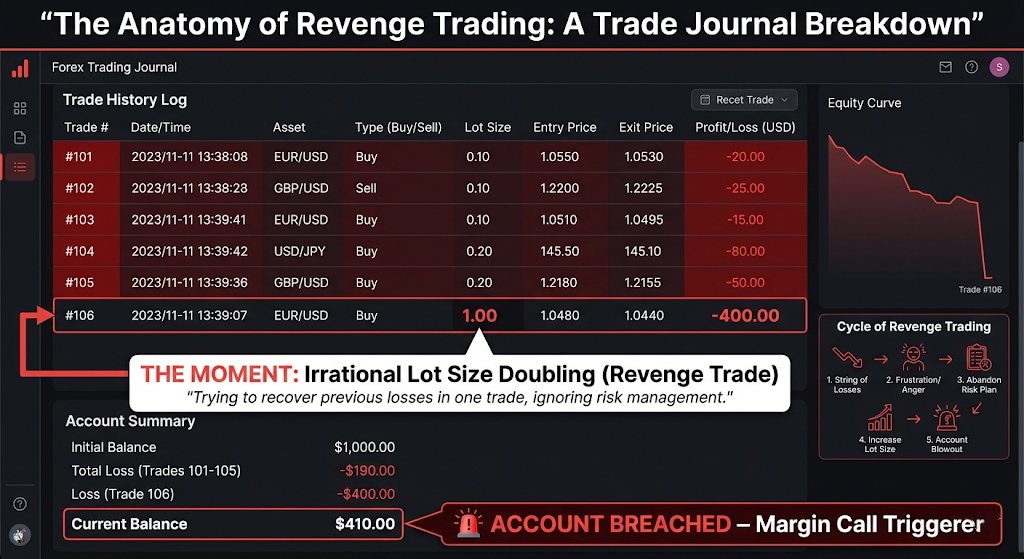
You enter a primitive "Fight or Flight" state. Because you cannot run away from the computer (flight), you choose to fight. You aggressively attack the market. You double your lot size. You remove your stop loss. You enter a position without waiting for a Killzone or an FVG. You are no longer trading; you are throwing punches in the dark. This is known in the industry as "Tilt."
You must forgive yourself for this biological reaction, but you must also engineer a system to prevent it from ever destroying your capital again.
Chapter 2: Step 1 - The Clinical Autopsy
When an account blows, your emotional brain will immediately try to protect your fragile ego by blaming external factors. You will say:
- "The broker deliberately slipped my order."
- "The prop firm rules are rigged."
- "The algorithm is hunting my specific stop loss."
You must silence this voice immediately. The market does not know who you are. The algorithm does not care about your $100k challenge. You must conduct a cold, clinical, data-driven autopsy on your trading journal to find the exact point of architectural failure.
The Mathematical Reality of the Blowout
Did you blow the account because your trading strategy suddenly stopped working? Highly unlikely. In 95% of cases, the failure is purely Risk Management.
Look at the math: If a prop firm gives you a 5% Daily Drawdown limit, and you strictly risked 0.5% per trade, you would have to lose 10 consecutive trades in a single day to breach the account. The statistical probability of a skilled SMC trader losing 10 perfectly executed A+ setups in a row in one day is nearly zero.
If you hit the daily drawdown, the autopsy will usually reveal one of two truths:
- You risked way too much per trade (e.g., 2% or 3%), making a normal 2-trade losing streak fatal.
- You revenge-traded, opening 5 or 6 rapid-fire trades out of anger without proper analysis.
Acknowledge the data without ego. Write down the exact rule you broke. The numbers do not lie.
Chapter 3: Step 2 - The Dopamine Detox (Mandatory Quarantine)
The absolute worst, most destructive action you can take after blowing an account is pulling out your credit card and immediately purchasing a brand new evaluation challenge.
Right now, your brain is swimming in stress hormones. You are operating from a state of pure desperation, looking to "win back" the dignity and the money you just lost. This is the exact psychological profile of a gambling addict sitting at a roulette table at 3:00 AM.
If you buy a new challenge while in this state of 'Tilt', you will inevitably blow the new account within 48 hours. It is a mathematical and biological certainty.
The 7-Day Quarantine Protocol
You must step away from the charts for a minimum of one full week. This is non-negotiable.
- Do not open MetaTrader.
- Do not look at TradingView.
- Do not watch "ICT Sniper Entry" videos on YouTube.
- Do not check Twitter to see other traders posting payouts.
You must let your dopamine receptors reset. The global financial market has been operating for over a hundred years; it is not going anywhere. It will be here when you get back. Use this week to rebuild your physical and mental health. Sleep 8 hours, go to the gym, spend time with your family, and actively detach your personal self-worth from the flashing red and green lights of the terminal.
Chapter 4: Step 3 - Re-Architecting the Risk Matrix
When you finally return to the markets after your quarantine, you cannot return with the exact same flawed architecture that caused your collapse. You must build systemic, unbreakable constraints.
You cannot trust your human brain in the heat of the moment; you must rely on hard rules.
1. The "Personal" Daily Drawdown
If your prop firm enforces a 5% Daily Drawdown, your Trading Plan must strictly enforce a 2% Personal Daily Drawdown. The moment you are down 2% for the day, you physically shut down your computer. You do not try to "make it back." You accept the small loss and return tomorrow with a clear head. This guarantees you will never accidentally trigger the firm's hard breach.
2. The Risk Slash Protocol
If you suffered a blowout, you lost your right to risk 1% per trade. When you return, you must slash your risk to 0.25% or 0.5% maximum per trade. The goal is no longer to make massive profits; the goal is to prove to yourself that you can execute your Trading Plan flawlessly without emotional attachment. Small risk removes the fear of losing.

Chapter 5: Step 4 - The Ego Death and The Scaled-Down Return
Here is the hardest pill to swallow: Drop your ego.
If you just blew a $100,000 or $200,000 funded account, do not buy another $100,000 account. You are not psychologically ready to manage that level of capital yet. The absolute dollar values of the drawdowns on a $100k account (e.g., floating minus $1,000) are too heavy for your currently fragile psychology.
Buy a $10,000 or $25,000 evaluation challenge. Yes, the payouts will be smaller, but that is irrelevant right now. You must prove to the man in the mirror that you can execute the process flawlessly on a smaller scale before you demand the privilege of managing massive institutional capital.
Frequently Asked Questions (FAQ)
Is it normal to feel depressed after blowing an account?
Absolutely. It is a severe psychological blow. You are mourning the loss of potential income, the loss of the challenge fee, and most importantly, the loss of trust in yourself. Acknowledge the pain, but do not let it define you. Every great trader has been exactly where you are sitting right now.
Should I switch to a new strategy after a blowout?
No. "System Hopping" is a fatal trap. Unless your clinical autopsy proves that your strategy mathematically lacks an edge over 100 trades, the strategy is not the problem. Your execution and risk management are the problems. Stick to your edge, but fix your mind.
How long does it take to recover psychologically?
It varies from trader to trader. For some, a 1-week dopamine detox is enough. For others, it may take a month of strict demo trading to rebuild the confidence required to press the execution button without fear. Do not rush the process. Capital preservation includes mental capital.
Conclusion: The Phoenix Protocol
Blowing a funded account is not the end of your trading career; it is the tuition fee required to enroll in the university of elite execution. The market will always aggressively expose your deepest psychological flaws. You can either let that exposure break you, or you can use it as a blueprint to rebuild a stronger, more disciplined version of yourself.
Take your break. Conduct your autopsy. Lower your risk. Drop your ego. When you return to the matrix, you will no longer be a naive beginner hoping for a payout; you will be a battle-tested digital mercenary. Rebuild the armor, respect the drawdown math, and execute your edge.