

Introduction: The $200K Ego Trap
The entire proprietary trading industry is fueled by a very specific, highly predictable psychological vulnerability: the retail trader's ego and profound impatience.
Every single day, thousands of beginner and intermediate traders clock into their 9-to-5 jobs, save up $1,000, and immediately purchase a massive $200,000 evaluation challenge. They do this because they are completely consumed by the mathematics of the final outcome. They sit at their desks with a calculator and think: "If I can just make a meager 5% on a $200K account, that is $10,000 a month! I can quit my job tomorrow!"
On paper, the math makes perfect sense. In reality, it is a psychological death sentence.
The psychological weight of managing a $200,000 account—seeing floating losses of -$1,500 on a single trade—combined with the immense pressure of the $1,000 non-refundable evaluation fee they cannot afford to lose, completely destroys their execution logic. They hesitate on A+ setups. They hold onto losers hoping they bounce back. They revenge trade to recover minor drawdowns. Within two weeks, the inevitable email arrives: Account Breached. They go back to saving up for the next one. This infinite loop of retail failure is the exact B-Book business model that makes prop firms hundreds of millions of dollars.
Professional digital mercenaries completely reject this ego-driven approach. They understand that prop firm capital is virtually infinite if you know how to architect your career properly. The true, mathematically proven path to 7-figure funding does not start with a desperate $200K gamble; it starts with a $10K seed and a brutal, systematic understanding of The Scaling Matrix.

Chapter 1: The Neuroscience of the $10K Seed Account
If you cannot pass a $10,000 challenge, you absolutely cannot pass a $200,000 challenge. The market structure is identical; the only variable that changes is your emotional response to the absolute dollar values.
A $10,000 evaluation challenge costs roughly $100 at most reputable prop firms. For most individuals in the Western world, and even ambitious traders in developing nations, $100 is an amount of money they can mentally and financially afford to lose. This single fact completely removes the psychological 'fear of ruin' from the trading equation.
The Desensitization Protocol
When you are trading a $10K account, you are not trading to buy a Lamborghini or quit your job next week. You are trading for one purpose only: To prove your algorithmic edge.
Because the financial pressure is neutralized, your execution becomes robotic and flawless. You easily risk your strict 0.25% or 0.5% per trade. A loss is only $25 or $50—it does not trigger an Amygdala Hijack. You wait patiently for the perfect New York Silver Bullet setups. You pass Phase 1. You pass Phase 2. You receive your refund, and you are now funded with $10,000 of live capital.
You have just planted the seed. Now, we apply the water. This is where the magic of the Scaling Matrix begins.
Chapter 2: Vertical Scaling (Using the Firm's Money)
There are two ways to scale your capital: Vertically and Horizontally. Vertical scaling means growing the capital within a single specific prop firm using their built-in growth plans.
Top-tier prop firms (like Funding Pips, FTMO, or FundedNext) desperately want to retain profitable, consistent A-Book traders because the firm takes a 10% to 20% split of your profits. Therefore, they offer aggressive built-in scaling plans to reward consistency.
The Standard Vertical Scaling Rule
While rules vary, a standard industry scaling plan dictates that if a trader can generate a total of 10% return over a 4-month period (an incredibly conservative average of just 2.5% per month), and process at least two payouts, the firm will automatically increase the initial account balance by 25% or 30%.
Let's map the mathematics of consistent 3% monthly returns on your $10K seed:
- Month 1-4: $10,000 Base. You generate 3% a month. You take your payouts. At month 4, the firm boosts your base to $12,500.
- Month 5-8: $12,500 Base. You continue 3% a month. At month 8, the firm scales you to $15,625.
- Month 9-12: $15,625 Base. At month 12, you scale to $19,531.
While this organic compounding is safe and excellent, it is far too slow for the ambitious architect. Vertical scaling is a passive bonus, not the main engine. To reach $1,000,000 in funding within 12 to 18 months, you must master the ultimate institutional secret: Horizontal Scaling.
Chapter 3: Horizontal Scaling (The Trade Copier Matrix)
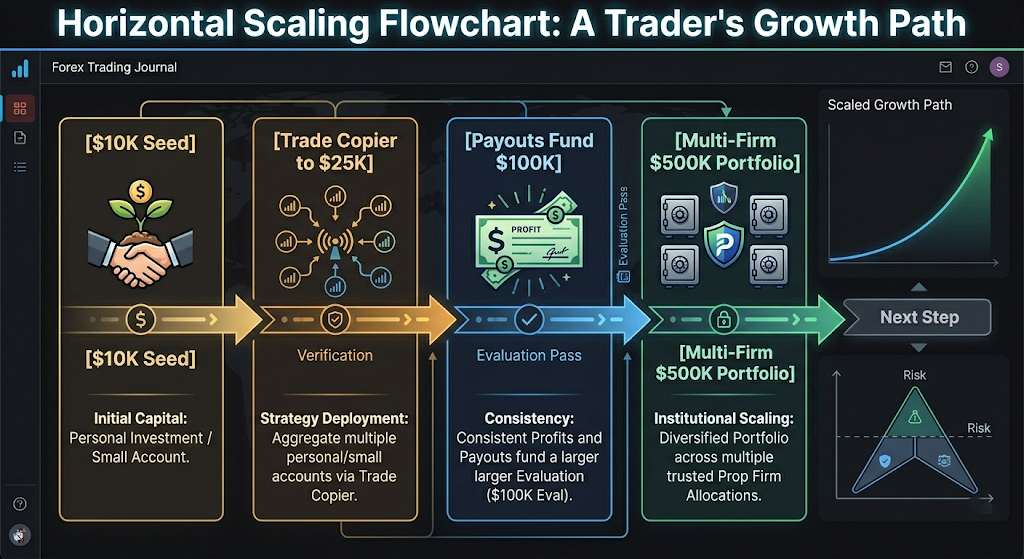
Horizontal Scaling is the process of using the profits from your initial seed account to aggressively purchase new, larger evaluation accounts across a diverse portfolio of different prop firms, and executing trades simultaneously across all of them using specialized software.
Step 1: The Reinvestment Engine
You have your funded $10K account. In Month 1, you make a 5% profit ($500). After the firm's split, your first payout is roughly $400. You do not spend this money on clothes or dinners. You are a business, and this is your R&D budget.
You immediately take $200 of that payout and purchase a $25,000 challenge at a different top-tier prop firm. You still have $200 profit in your pocket, meaning your actual risk on the new challenge is absolutely zero. You are playing entirely with house money.
Step 2: The Software Architecture (Trade Copiers)
You do not trade the $10K account and the new $25K account separately. That would cause mental fatigue and divergent risk profiles. Instead, you utilize professional cloud-based Trade Copier software (such as Social Trader Tools, Quantower, or Trade-Copier.com).
You link your master $10K funded account to your new $25K evaluation account. You open your charts and only execute trades on the $10K account. In less than 10 milliseconds, the software automatically copies your trade, mathematically adjusts the lot size to match the 0.5% risk profile of the $25K account, and executes it.
Step 3: The Snowball Effect
Because your psychology is fully stabilized—you are only mentally trading the tiny $10K account you are already comfortable with—you pass the $25K challenge effortlessly. You are now actively funded with $35,000 total.
In Month 2, you make 5% on your $35K portfolio. Your payout is roughly $1,400. You take $500 of that payout and purchase a $100,000 challenge at a third prop firm. You link it to the copier. You pass it.
By Month 4, you are trading a combined portfolio of $135,000. You are risking exactly 0.5% per trade across the board. You are executing the exact same setups. But now, a 5% monthly return yields a payout of $5,400. You use $1,000 of that to buy a massive $200K challenge at a fourth firm.
Chapter 4: The 12-Month Portfolio Blueprint
If executed with strict discipline, the timeline of a Digital Mercenary looks like this:
- Months 1-2 (The Foundation): Pass the $10K seed account. Secure the first payout. Establish the psychological baseline.
- Months 3-5 (The Expansion): Reinvest payouts to acquire a $25K and a $50K account via Trade Copiers. Total Capital: $85K.
- Months 6-8 (The Acceleration): Use the larger payouts from the $85K portfolio to pass two $100K accounts. Total Capital: $285K.
- Months 9-12 (The Institutional Level): Use the massive cash flow to max out allocation limits at top firms (buying $200K challenges). Total Capital: $500K to $1M+.
You reached $1,000,000 in funding. What was your total out-of-pocket risk? $100. The cost of the initial $10K seed account. Everything else was built using the market's own money.

Chapter 5: Counterparty Risk & Hedging the Matrix
Why use multiple different prop firms instead of just passing one massive $500K account at a single firm? The answer is Counterparty Risk.
The retail proprietary trading industry is largely unregulated, highly competitive, and extremely volatile. Prop firms can (and frequently do) change their rules overnight, migrate to different trading platforms (like the recent MetaQuotes bans), freeze payouts for audits, or go bankrupt entirely (as the industry witnessed with massive players like MyForexFunds).
If you have $500K at one firm and that firm shuts down, your career is instantly destroyed. Your cash flow drops to zero overnight.
By horizontally spreading your $500K capital across 4 or 5 different reputable firms (e.g., $100K at Firm A, $100K at Firm B, $200K at Firm C, $100K at Firm D), you are aggressively hedging your counterparty risk. If Firm B goes bankrupt tomorrow, it is a minor annoyance. You still have $400K in active funding across the other firms generating thousands of dollars a week. You simply use your next payout to replace Firm B with a new challenge at Firm E. You become bulletproof to industry volatility.
Frequently Asked Questions (FAQ)
Are Trade Copiers allowed by Prop Firms?
Yes, the vast majority of legitimate prop firms allow you to use Trade Copiers to mirror trades between your own personal accounts. What they strictly prohibit is copying trades from a third-party signal group, an EA used by thousands of others, or managing accounts for other people. As long as you are the master executing the trades, horizontal scaling is perfectly legal.
Is it confusing to manage different drawdown rules?
It can be. This is why you must standardize your risk. Firm A might have a 5% limit, while Firm B has a 4% limit. Your master account must be calibrated to respect the strictest rule in your portfolio. If you strictly risk 0.25% or 0.5% per trade, you will never come close to breaching a 4% or 5% daily drawdown, regardless of the firm's specific metrics.
What happens if the Trade Copier lags or disconnects?
Professional cloud-based copiers (like Social Trader Tools) run on dedicated servers with millisecond latency. However, tech failures happen. Always monitor your slave accounts periodically to ensure limit orders and stop losses are mapping correctly. Never trade massive tier-1 news events (like NFP) with a massive portfolio without expecting some minor slippage variations between different brokers.
Conclusion: Architect Your Empire
The 99% of retail traders are playing a lottery. They are gambling $1,000 on massive challenges, blowing them due to psychological pressure, and enriching the prop firm industry. They are operating on ego.
The 1% operate as digital architects. They check their ego at the door. They plant the $10,000 seed. They master their internal psychology in a stress-free environment. They leverage software to mathematically duplicate their edge across a diversified, risk-hedged matrix of prop firms. They compound their way to the top of the digital food chain without ever risking their own hard-earned savings.
Stop gambling. Start building the matrix.