

Introduction: The Hidden Fine Print of the Prop Industry
The modern proprietary trading industry has democratized finance, creating more independent millionaires than at any other point in retail trading history. Firms like FTMO, Funding Pips, and TopStep give everyday traders access to $100,000, $200,000, or even $1,000,000 in virtual capital. You pass an evaluation, you trade their capital, and you keep up to 90% of the profits. It sounds like the ultimate financial utopia.
However, the prop firm business model is not a charity; it is a highly calculated, risk-averse mathematical enterprise. While they proudly advertise their massive profit splits and loose trading rules on their homepage, the true battlefield lies buried deep within the fine print of their Terms of Service—specifically, within their Drawdown Mechanics.
Every single month, thousands of brilliant, technically gifted analysts blow their funded accounts. They do not fail because their strategy was poor. They do not fail because they lacked discipline. They fail because they fundamentally misunderstood the mathematical difference between Balance-Based, Equity-Based, and Trailing Drawdowns.
To survive as a digital mercenary in the prop firm arena, you must not only master your charting strategy, but you must also master the specific risk architecture of the firm you are trading for. A strategy that prints consistent payouts on a Balance-based firm might instantly blow your account on an Equity-based firm. In this Zemach Media masterclass, we will completely decode the drawdown matrix.

Chapter 1: The Core Metrics - Balance vs. Equity
Before we dissect the rules, we must define the two most critical numbers on your trading dashboard: Balance and Equity.
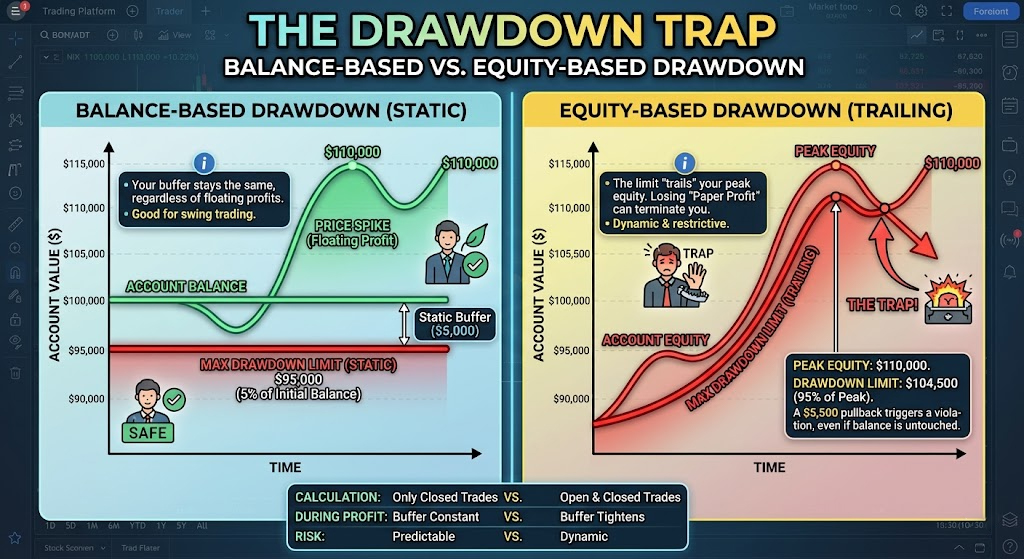
- Account Balance: This is your realized, hard capital. It only changes when a trade is completely CLOSED. If you have a $100,000 account and you are currently in a trade that is floating $5,000 in profit, your Balance is still exactly $100,000.
- Account Equity: This is your fluid, dynamic capital. It calculates your Balance PLUS your current floating, open positions. In the scenario above, while your Balance is $100,000, your Equity is floating at $105,000.
The trap is set when prop firms use your fluid Equity to calculate your fixed failure limits.
Chapter 2: Balance-Based Drawdown (The Trader’s Sanctuary)
Balance-based daily drawdown is the absolute gold standard of the industry. It is the most forgiving, logical, and trader-friendly rule in existence. If you are a serious trader, you should actively hunt for firms that offer this model.
Under this rule, your daily loss limit is calculated strictly on your account Balance at the start of the new trading day (usually 5:00 PM EST). It completely ignores your floating equity during the day.
The Balance-Based Math:
Imagine you have a $100,000 account with a strict 5% daily balance-based drawdown rule.
- At 5:00 PM EST, your balance is $100,000. Your daily loss limit is calculated: 5% of $100,000 is $5,000.
- Your exact violation line (the point where you lose the account) is locked in at $95,000.
- You enter a long position. The algorithm violently pushes price in your favor, giving you a massive $4,000 floating profit (Your Equity is now $104,000).
- Because you are targeting a higher macro liquidity pool, you hold the trade. Suddenly, high-impact news drops, the market violently reverses, and your trade hits your original stop loss, closing at a $500 loss.
The Outcome: Under a balance-based rule, you are perfectly safe. Your new account balance is $99,500. You are still $4,500 away from your $95,000 violation limit. This rule allows swing traders to let their winners run, absorb deep pullbacks, and execute Smart Money Concepts (SMC) without psychological terror.
Chapter 3: Equity-Based Drawdown (The Algorithmic Trap)
Equity-based daily drawdown is the silent killer of retail funded accounts. It is designed mathematically to fail traders who do not understand it. Under this rule, your daily loss limit is calculated based on your starting balance OR your highest floating equity of the day—whichever is higher.
The moment your trade goes into profit, the prop firm's algorithm drags your failure line up with it, effectively penalizing you for having a winning trade that you did not close immediately.
The Toxic Equity Math:
Let us use the exact same scenario. You have a $100,000 account with a 5% Equity-based drawdown.
- Your initial violation limit for the day starts at $95,000.
- You enter a trade. It rockets up, and you are floating $4,000 in profit. The firm's server registers your peak equity for the day at $104,000.
- Because the rule is equity-based, your new 5% daily drawdown limit is recalculated from that $104,000 peak! (5% of $104,000 is $5,200).
- Your new, invisible violation level is immediately dragged up to $98,800 ($104,000 - $5,200).
- The market reverses. Your trade drops from $4,000 in profit all the way back to your breakeven entry point. You close the trade for $0 profit.
The Devastating Outcome: Your account balance is $100,000. You did not lose a single dollar on the trade. However, because your equity dropped from its peak of $104,000 down to $100,000, you have suffered a $4,000 intra-day equity loss.
Remember, your violation line was moved to $98,800. This means you only have $1,200 of usable drawdown left for the entire day! You are on the verge of losing a $100,000 funded account despite never actually taking a losing trade. This psychological trap causes traders to panic, overtrade, and ultimately fail.
Chapter 4: The Intraday Trailing Drawdown (The End Boss)
Often found in Futures prop firms (like Apex or TopStep), the intraday trailing drawdown is the most aggressive and unforgiving rule in existence. It operates similarly to the equity-based rule by trailing your highest open profit.
However, there is one terrifying difference: It never resets.
While an equity-based Forex prop firm will reset your daily drawdown limit every day at 5:00 PM EST, giving you a fresh start, the Trailing Drawdown locks in your High-Water Mark permanently until your trailing limit reaches your initial starting balance.
- You start with $50,000. Your trailing drawdown is $2,000 (Violation at $48,000).
- You have a great week and your floating equity hits $53,000. Your trailing drawdown follows you up, meaning your permanent violation level is now locked at $51,000.
- If you suffer a normal, statistically expected losing streak over the next week and your balance drops to $50,500, you lose the account.
You blew your account while you were still $500 in pure profit! This rule is explicitly designed for high-frequency, aggressive scalpers who get in and out of the market in seconds. It completely invalidates swing trading.
Chapter 5: The Architect's Execution Strategy
If you are already funded with an Equity-based or Trailing firm, you cannot change their rules. You must change your architecture. Here is how you survive:
1. Abandon the "Home Run" Mentality
If you are on an equity-based account, you cannot hold trades for massive 1:5 or 1:10 Risk-to-Reward targets. The algorithmic pullbacks required to reach those targets will trigger your equity drawdown. You must become a ruthless extractor. If your trade hits 1:2 RR, close the trade entirely.
2. The Aggressive Partial Protocol
If you insist on holding for higher targets, you must take heavy partial profits. When price reaches a 1:2 RR, close 75% of your position. By closing the position, you convert "floating equity" into "realized balance," locking the money into your account and preventing the equity algorithm from using that profit against you if the market retraces.
3. Trade the New York Killzone Only
Equity-based accounts require fast, violent expansions that hit Take Profit targets quickly without pulling back. The only time the market provides this volume is during the London Open and the New York AM Session (8:30 AM - 11:00 AM EST). Never hold trades into the dead Asian session, as the slow consolidation will bleed your equity.
Frequently Asked Questions (FAQ)
How do I know which rule a Prop Firm uses?
You must dive into their FAQ or Help Center. Search for the terms "Daily Drawdown" or "Daily Loss Limit." If the documentation says "calculated based on the higher of your starting balance or equity," it is an Equity-based firm. If it says "calculated based on midnight balance," it is a Balance-based firm. Firms like Funding Pips and FTMO generally use Balance-based daily limits, making them industry favorites.
Does moving my Stop Loss to Breakeven protect my Equity Drawdown?
No! This is the biggest misconception. If you move your stop loss to Breakeven, you are protecting your Balance. But if the trade floats $3,000 in profit and then retraces to hit your Breakeven stop, your Balance is safe, but you still suffered a $3,000 drop in Equity. The prop firm will count that $3,000 drop against your daily loss limit.
What is the Maximum Overall Drawdown?
This is separate from the Daily Drawdown. The Maximum Overall Drawdown (usually 8% or 10%) is the absolute limit your account can fall below its initial starting balance. This is almost always static (meaning a $100k account is blown if it hits $90k, regardless of profits made), but always verify this in the firm's specific rules.
Conclusion: Master the Rules of Engagement
Earning a funded account requires elite technical analysis. Keeping a funded account requires elite risk architecture. You are not trading against the market; you are trading within a highly controlled matrix designed by the proprietary firm. Read the fine print, respect the mathematics of equity vs. balance, adjust your take-profit strategies accordingly, and protect your digital real estate at all costs.